


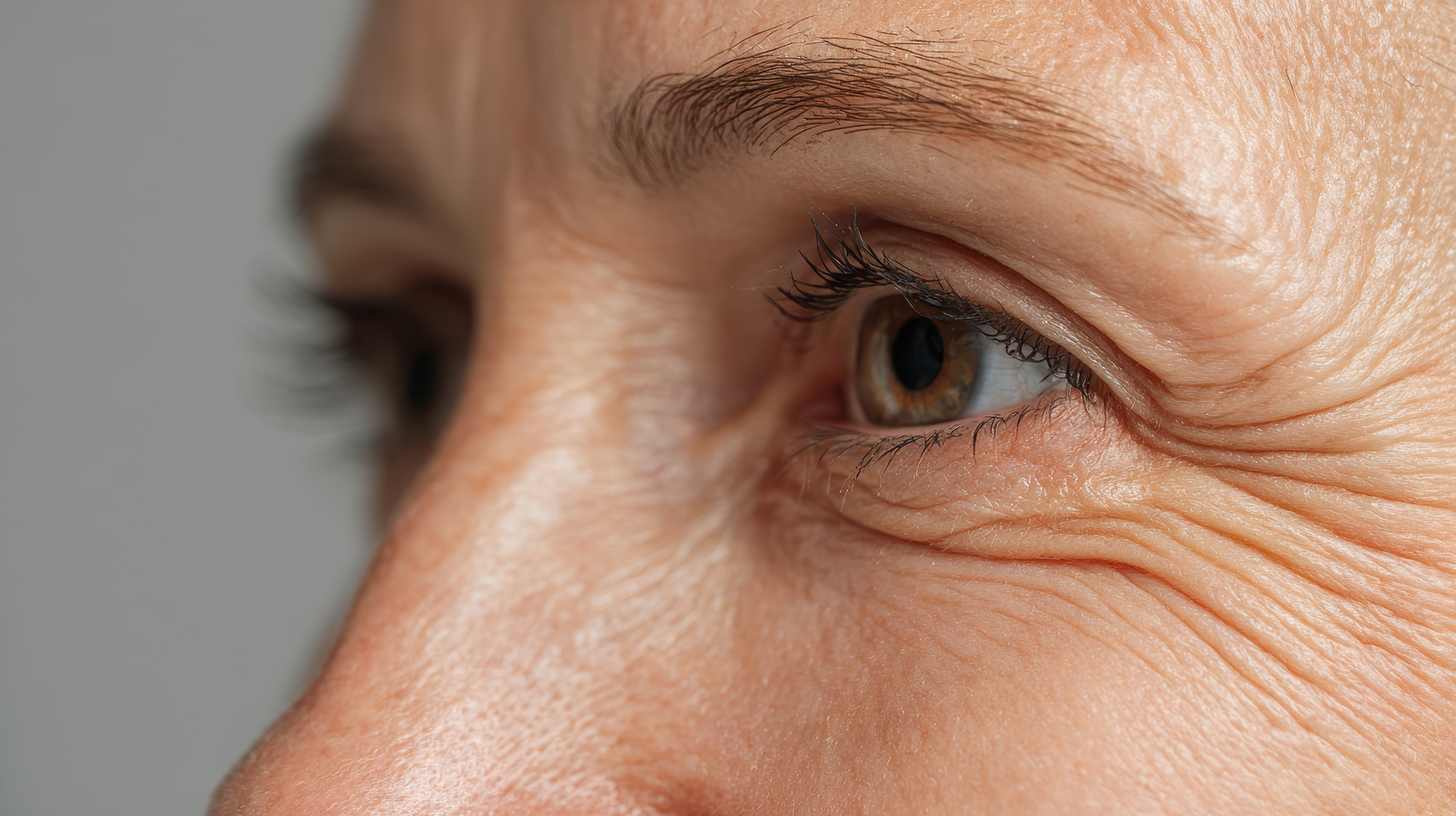

Treating Crow’s Feet:
Botox Treatment for Eye Wrinkles
Smile lines are very charming and should definitely be preserved. However, when the lateral wrinkles at the outer corners of the eyes also cause the cheek area to crease, they are often perceived as bothersome.
Through finely dosed injections of botulinum toxin, this excessive wrinkle formation can be inhibited while maintaining your natural, friendly smile.

Frequently Asked Questions about our Crow’s Feet Treatment
Can I resume my normal activities after the crow’s feet treatment?
You should avoid tilting your head too far downward to prevent the formation of small bruises. If necessary, the treated areas can be cooled again at home. For up to 2 days after the treatment, no sauna sessions or athletic activities should be planned. Refraining from alcohol and nicotine is also advisable.
You are welcome to “activate” the treated areas after the procedure (frowning, squinting). This promotes the distribution of botulinum toxin in the tissue and thus the effectiveness of the therapy.
How often can I treat crow’s feet with Botox?
The effect of botulinum toxin is temporary; the active ingredient is broken down by the body, allowing the previously relaxed muscle to contract again. With repeated injections, the muscle becomes weaker, meaning the intervals between Botox injections usually become longer. Botox treatments can be repeated as often as desired.
Can side effects occur during crow’s feet treatment?
Side effects occur very rarely. Temporary small bruises or minimal redness may occur at the injection sites. In rare cases, headaches may occur 24 hours after the injection. When using botulinum toxin, we place particular emphasis on a natural facial expression. We do not consider a “frozen” look to be desirable.
When should crow’s feet not be treated with botulinum toxin?
Contraindications:
Treatment with botulinum toxin-A (Botox) must not be performed if:
- There is a known hypersensitivity to botulinum toxin or any of its other ingredients.
- There is a generalized disorder of muscle activity (e.g., Myasthenia gravis).
- Acute infections or inflammations exist in the area of the injection site.
- You are pregnant or breastfeeding.
Whether a treatment is sensible and safe for you will be discussed individually during a personal consultation.